The Creation

For the expansion/contraction after the big bang of our universe there are 2 numbers to begin with :
- half-life rate : 6,347,755,102,040 years
- initial speed of light : 44,069,497.500 km/s
At each step (called an hyperspace or a period) the half life number is added and the speed of light is divided by 2 :
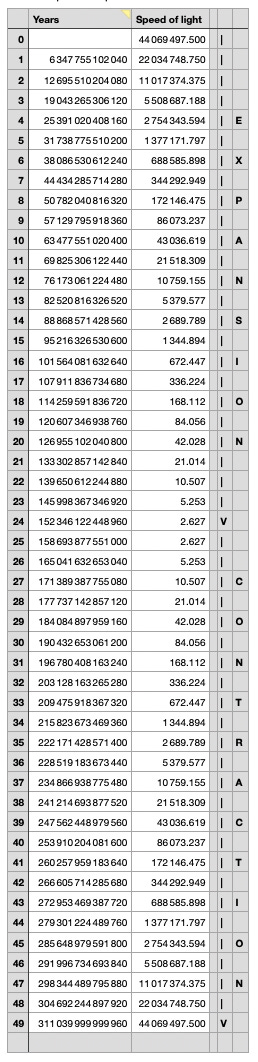
Our actual speed of light is : 299,792.458 km/s.
Almost, we don't have a very precise number, What is the speed of light NOW to the nearest nanosecond and micrometre/s ? We don't know.
Because we do not have the technology to do so and we consider it to be a constant, which is not the case.
Actually the speed of light decreases annually by 27.119 µm/s
We can therefore calculate the age of our universe.
So we are at the 7th hyperspace : 44,434,285,714,280 years and 344,292.949 km/s
Which gives :
factor for speed = initial speed of light / reference speed of light
exponent = log2(factor for speed)
factor for speed = 44,069,497.5 / 299,792.458 = 147.00002059424725
exponent = log2(147.00002059424725) = 7.199672546953482
So we multiply this exponent with the half life period.
Number of years = 6,347,755,102,040 * 7.199672546953482 = 45,701,758,142,941.29 years
More precisely : 45,701,758,142,941.28645562066809932933 years
To get the speed of light from the numbers of years, we must therefore perform the inverse calculation :
exponent = Number of years / half life period
speed of light = initial speed of light / 2^exponent
exponent = 45,701,758,142,941.29 / 6,347,755,102,040 = 7.199672546953482
speed of light = 44,069,497.500 / 2^ 7.199672546953482 = 299,792.458 km/s
The age of our universe : 46 trillion years
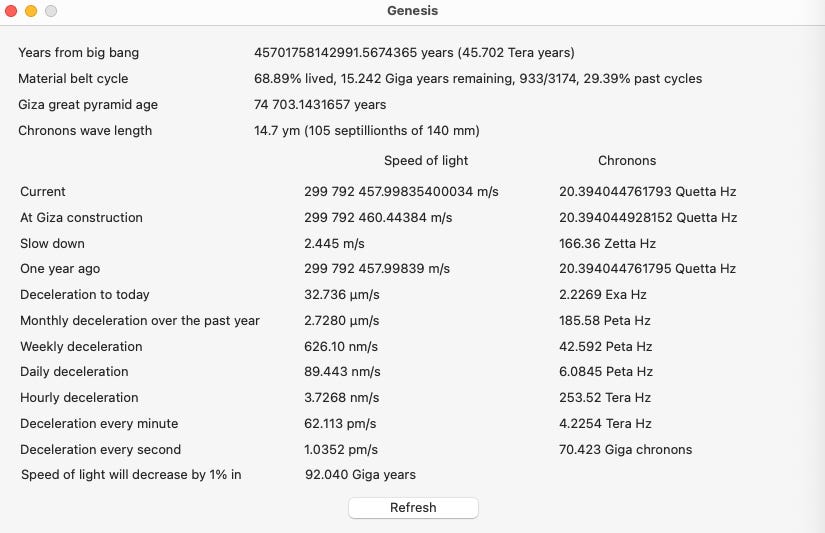
So we have the total expansion / contraction of : 311,040,000,000,000 years
This is called a great time or a creation day (311 trillion years).
Material and spiritual form created only in the first expansion. 311/2 during 155 trillion years.
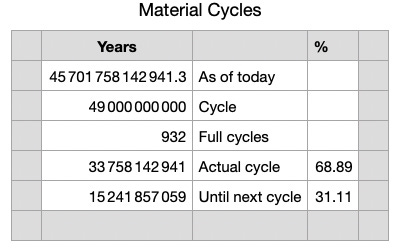
The material belt of the creation renew itself every 49 billion years.
In the course of the last 3 billion years of the transitionless renewal of the material belt it occurs that all life forms reach their highest stage of development and their spirit-forms go on into higher spirit levels.
Creation evolution step
Prior to the big bang : 3 birth phases of 3 great times each. Sleep Wake Sleep
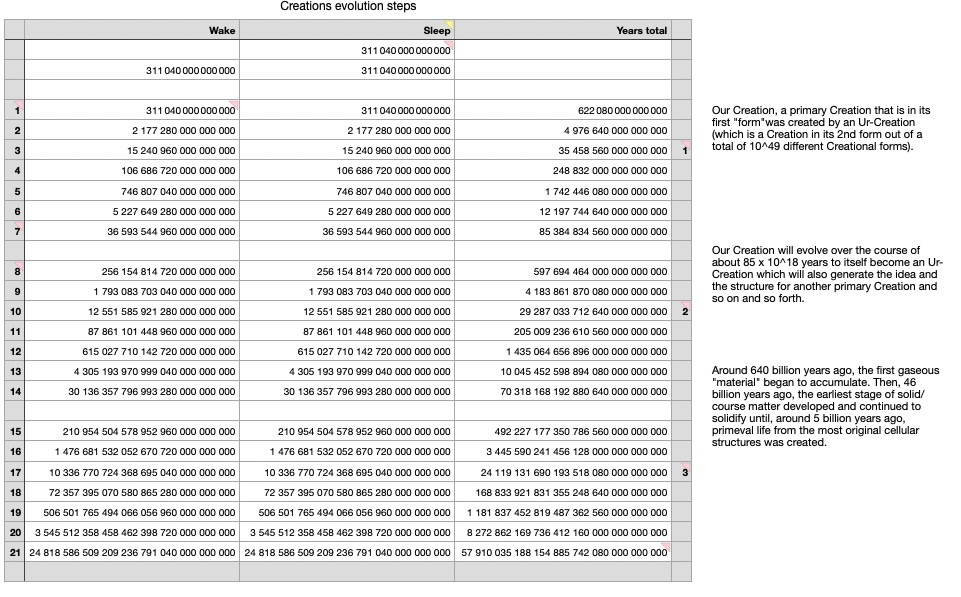
So we have these 3 first evolution creation step in this chart.
This goes to 10^49. The total of years being 7^(10^49). 1 and 10^50 zeroes.
At this stage it enter to the absolute absolutum.
7 BEING-Absolutum
6 Sohar-Absolutum
5 Super-Absolutum
4 Creations-Absolutum
3 Central-Absolutum
2 Ur-Absolutum
1 Absolute Absolutum.
The Absolute Absolutum is the one Absolutum-form that created the very first and lowest Creation-forms, the very first material universes, which evolved up to the first Ur-Creations which on their turn created new material-universe Creations.
The other six (6) Absolutum-forms do not create universes / creations.
Number of creations that have already reached the absolute absolutum until the creation of our universe 46 trillion years ago is 7.3 10^701392 = 1 Zahlanon
All creations float in a void (nihilo). Matter being a sizeable idea (idea-> energy-> matter), where did the initial idea come from, the first form of energy that created the BEIN-Absolutum? We have no way of knowing, because it is impossible to understand what does not exist. (Nihilo)
There is a discussion about this with Billy here.
References :
What is the Creation
Contact 119
Chronons time travel
Cycles of the Material Belt and Universes Within the Creation
How did our universe and our world come into existence ?
Zahlanon, Time anon
Videos:
The Creation - How It All Began
The Evolution of the Creation
The Seven Belts of the Creation
Number of creations
The speed of light
The speed of light in the Seventeenth General Conference on Weights and Measures (October 1983) to maintain unchanged the value of the speed of light recommended in 1975 by the Fifteenth General Conference on Weights and Measures in its Resolution 2, c = 299,792,458 m/s
In fact, it is an accepted weighted average value, determined from three measurements :
Translated (p 68 15th CGPM) :
Considering, on the other hand, the needs in the fields of astronomy, geodesy, and geophysics, the C.C.D.M. decided to recommend a value for c.
The three recent measurements leading to precise values for the speed of light in a vacuum and discussed by the C.C.D.M. are:
1° The measurement of the frequency of the methane-tuned laser with its wavelength value already recommended, which gives
c = (299,792,458.3 +/- 1.2) m/s
2° The measurement of the frequency of the R(12) line of carbon dioxide with its wavelength determined, which gives
c = (299,792,457 +/- 6) m/s
3° Bay el Luther's measurement, which uses microwave modulation of the visible radiation of a helium-neon laser and gives
c = (299,792,462 +/- 18) m/s
Due to the significant difference in uncertainties, which are 4.10^9, 2.10^-8 and 6 x 10^8 in relative terms, only the first of the three results is important for determining the weighted average value, which is
c = 299,792,458 m/s
Resolution 10 of the 15th CGPM (1975) see p 68
Resolution 1 of the 17th CGPM (1983) see p 14
As we know according to the Seventeenth General Conference on Weights and Measures (October 1983) the meter is the length of the path traveled by light in a vacuum during a time interval of 1/299,792,458 of a second.
One second as defined by Billy Meier :
One second equals the time light needs to travel 299,792.5 km in space.
Time itself consists of chronons, which is why the smallest unit of time is called a chronon. The number of chronons determines the second, where the chronons are related to present time. If these flow, by the expiry of time, into the past, then they become Tachyons, which will maintain the previous chronon speed, even when time has changed through the steady deceleration of the light constant.
The chronon has a wavelength or wave distance of 105 septillionth of 140 millimeters. (λ 14700 x 10 ^-24 mm, f= 20.39404762 x 10 ^ 30 hertz). Now, should the time of one second be measured, it is simply necessary to form a fixed flow point at which it is measured, how many chronons by this measurable point are passing through in the area from the beginning to the end of a beam of light of a certain length.
The number of chronons passing through gives, on one hand the speed of the second, on the other hand however, the distance as well. So if then for example from the beginning to the end of a light beam of 299’792.5 kilometres 20,39404762 x 10^30 (Nonillion) chronons passes through the measuring point then it gives the speed of a second with a passage distance of the light of 299’792,5 kilometers. This corresponds quite exactly to the current light second in kilometre, as well as one second as a small time unit of one earth day.
--
The wave length of the chronons is 14.7 yoctometer
Frequency = Speed / Wave length
Speed of light = 299,792,458 m/s (as of May, 26, 1975)
Chronons frequency = 299,792,458 / 1.47 * 10^-23
= 20,394,044,761,904,763,588,225,306,322,783.65413928052943091464
Chronons frequency = 20.39 10^30 Hz (Quetta Hz)
According to the spreadsheet i made in the 1st post of this topic we see the speed of light is falling (not so much because it is 32µm/s per year, The speed of light will decrease by 1% in 92.04 billion years).
"Every dwindling away of a half-life thus creates its own hyperspace, whereby seven different hyperspaces or half life hyper spaces already exist in our universe which are further divided into countless more normal hyperspaces which have originated through the decline of the STEADILY FALLING light speed.” See the 1st spreadsheet."
There is therefore a direct relationship between the speed of light and chronons, via the wavelength of chronons.
The speed of light decreasing, the chronons frequency decreasing too.
"If for example tachyons, with a higher light speed than of those in normal space and the present of the material universe in any given hyperspace, is stored around a flying object, it is automatically flung into the past, while a chronon flow below our present speed of light results in a trip to the future."
So we can calculated the frequency needed for a travel to 1000 years in the past (year 1025) :
We calculated before the age of our universe , the numbers of years : 45,701,758,142,941.29
substract 1000 years : 45,701,758,141,941.29
45,701,758,141,941.29 / 6,347,755,102,040 = 7.199672546795946
speed of light = 44,069,497.500 / 2^ 7.199672546795946 = 299,792.45803273603 km/s
The speed of light 1000 years ago was 299,792.45803273603 km/s
The chronons frequency was 299,792,458.03273603 / 1.47e-23 = 20.394044764131703 10^30 Hz
By storing around the ship the chronons at 20.394044764131703 Quetta Hz we go to the past 1000 years.
We can therefore see that we need to be very precise when it comes to the speed of light.
The current value is a weighted average dating back to 1975.
So, if we are to travel to the past or future in 1 or 2 days, the speed of light must be very very precise and accurate.
References :
Time travel
Contact 119
Consequently :
From a date we have the speed of light.
From a speed of light we have the date.
Chronon frequency = Speed of light / wave length of the chronon. (14.7 ym (yocto meter))
From a date we have the chronon frequency.
From the chronon frequency we have a date.
So by surrounding the ship with chronons at the desired frequency, we can travel to the past or the future at a specific date.